|
Cost-effective 'pick and place': A tough nut to crack?
June 2005
The cost of labour is well understood in all industries; as jobs are exported to low-cost countries, manufacturing declines. So what can be done to improve industry efficiency and reduce operating costs?
The automotive industry was at the vanguard of introducing automation to the shop floor, with many completely automated systems being designed and deployed. However, this has not been the case in most other industries where human labour is still very much relied upon to handle the 'product' itself.
Whereas the automotive industry uses robots to automate human activities, others - especially the food industry - have not followed this path. The reason being? Robots are generally perceived as being expensive, complex, over-specified and the equivalent of using a sledgehammer to crack a nut.
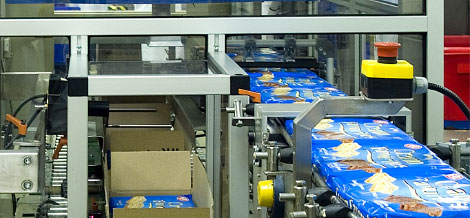
That said, the labour cost problem remains. Large investments are made in machines and conveyors to allow discrete operations to be completed very efficiently in food process packing. Typical applications in the post-cooking or processing stage of food manufacture include can-labelling, packet filling, shrink-wrap packaging of trade packs, labelling, box-filling, mixed product promotional pack filling and product sorting. Usually a labelling, shrink-wrapping or other machine is purchased from a specialist OEM, and the intermediate handling is done by conveyors using operators to Pick & Place products, or product components, as required.
Yet the operator's role is increasingly the focus of much legislation and regulation, working time directives, health issues such as RSI, and hygiene. Additionally, human operators can be the source of many mistakes that lead to quality issues and which can result in severe penalties by large retail customers.
Automation in industry
So, can the automation techniques employed by the automotive industry be employed in more general processing and production applications? In theory, yes, but in practice there is no real application fit. Typical handling solutions in the automotive industry are not those that are required in the handling of, for example, food products. Indeed, there is a common view in the food industry that investments in robot technology will never deliver any real return and are costly both to procure and to maintain.
Yet the requirement for greater operational efficiency remains. So what is the solution? It's important to start with the appraisal of a typical Pick & Place application and the recognition that most requirements can be summarised as addressing speed, cost, payload, reliability, ease of use and 'footprint'.
Clearly, a handling system must be technically up to the task in hand - it must traverse the distances that are needed, must complete the task quickly, have a small enough footprint to fit on existing production lines and, importantly, be able to move the required payload again and again.
Equally, a system must be reliable (it has to keep working and be able to execute the handling task reliably), and it must be simple to deploy, program and maintain and be able to synchronise with existing equipment.
Finally, the system must be quantifiable to all-up employment costs (per operator or possibly two operators depending on the complexity of the handling task) and show a return on investment in the shortest possible time!
Motion control expertise
If this is a reasonable specification, then from where should a solution be procured? All suppliers are rooted in their experience; it would therefore seem to be a tall order for established, industrial robot suppliers to completely re-invent themselves as specialist solution providers for general processing industries, including food production. However, the fundamental components of what is required by general production can be found in the expertise of motion control companies.
The food and packaging industry, for example, has for many years been familiar with the use of product indexing, placement and synchronisation. Packages are evenly placed on a conveyor, cans are queued until a release is triggered and rolls of material are uniformly unwound. The appearance of everything seems to be connected, but by no visible means. Motion control companies have long since mastered the art of accurately and dynamically positioning products and components so that they can be manipulated in a regular, repeatable and orderly fashion. Indeed, the solution is best provided by motion control companies that can additionally deliver the mechanical part of a handling system in addition to their traditional core competencies.
A nutcracker to crack a nut: R-Theta
Leading motion control and positioning experts, Quin Systems, have introduced a Pick & Place system, R-Theta, that provides a combination of their proven motion control technology and innovative mechanical hardware. It was specifically designed from the ground up for food industry Pick & Place applications.
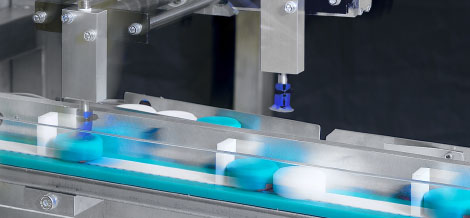
The R-Theta Pick & Place system is a field tested device that provides a real benefit solution to the food and packaging industry sectors. In its simplest consideration it can replace many repetitive functions that currently may be performed by operators.
The system has been designed with constant attention to meeting the functional requirements and the business requirements of the industry. The 100 Pick and Place movements-per-minute rating applies to complete cycles; full there-and-back motions. Payload at this work rate is at least 1kg, with 10kg being possible at a reduced rate. This rating applies to a working zone of 600 x 300 mm which is fully scaleable – a real strength in the design of the system. The gripper in this application is an advanced vacuum device.
All these characteristics meet the specific needs of most packaging, box-filling and many other food industry handling tasks. Two and three axes versions are provided to meet the complexity of motion path required by the application.
The R-Theta system is built from standard Quin modules. It has digital drives, a decentralised multiprocessor control (that is each component part has its own intelligence and communicates with the others when needed); it is networkable and will readily integrate with de facto networking standards such as Ethernet TCP/IP, Profibus and Device Net.
Ease of use and cost effectiveness.
The potential additional issues that have been addressed beyond the technical offer are the answers to essential questions such as "is it simple?", "will my operators be able to use it?", "and how can I be sure of return on investment?"
Quin has accurately anticipated these fuller, and real-world aspects of Pick & Place procurement. So, whereas most robot manufacturers charge separately for unit and the gripper without which it is useless, Quin's offer includes the Pick & Place unit, a gripper, software and integration.
Quin is a specialist in motion control synchronisation and therefore easily provides optimised integration solutions. Training and support are, of course, provided. Actual 'programming' of the motions of the unit is very simple and is done graphically via a touch screen on a step-by-step intuitive basis. Subsequent changes can be easily made if the unit is re-deployed. The system can store new motion sequences as 'recipes' for different products and also has the facility to manually 'teach' the system to follow the path of the gripper head.
Return on investment has been uppermost in mind during the development of R-Theta. The system is engineered to meet the particular requirements of the food and packaging industries, as opposed to being rich in unnecessary features from a different industry with radically different requirements. Taking this 'green-grass' approach has produced a system that will meet the requirements of the user and will help prevent the loss of manufacturing to low-cost economies simply on the grounds of labour cost.
The added tireless functional reliability of automated Pick & Place should contribute to a reduction in the risk of recalls and retailer complaints, and will help in delivering regulatory compliance in traceability and food hygiene.
Mike Webb, Managing Director of Quin Systems, says: "The R-Theta solution combines our years of expertise and experience in motion control applications and an innovative mechanical design. Putting the two together has produced a system that should be truly attractive to the food, beverage, packaging and pharmaceutical sectors, placing automation well within the grasp of industry as a whole.
"Finally, a solution exists to meet the specific needs of industrial Pick and Place applications - so why use a sledgehammer when a nutcracker will do the job best?"
What To Look For in a Pick and Place Solution:
- It must traverse the distances that are needed (the stroke)
- It must do the task quickly (motions per minute)
- The cost has to provide savings against all-up employment costs and show a return on investment from day one
- The payload (amount it can move) must correspond with your specific products
- The footprint of the Pick & Place unit must be such that it can be positioned close to existing equipment to undertake the task in the operator's space
- The unit must be able to synchronise with existing equipment
- The system has to be reliable - in terms of "up-time" and in the task it performs
- The unit has to be simple to deploy, program and maintain
|