As a leader in the development of high performance linear motors, LinMot have in the last few years pioneered combined Linear and Rotary motors. These provide independently controlled linear and rotary motions on one shaft with great advantages for Capping , Screwing and Assembly applications.
The growing PR01 Linear Rotary family of motors has now been extended to the new PR02 compact version which is available in 3 sizes, with extra features such as optional torque sensing and built-in mass compensation in the case of power-loss using their unique MagSpring technology.
Advantages
The PR02 offers many advantages such as the free parameterisation of linear and rotary movement including speed, position, acceleration and current (Torque or force) with the option of a built-in torque sensor for high-accuracy applications. This is all available in a compact design, that is easy to integrate in one physical axis, with independent programmable linear and rotary motion. The PR02 is compatible with the needs of IIoT offering Real-Time Data Evaluation and Real-Time Parameterisation.
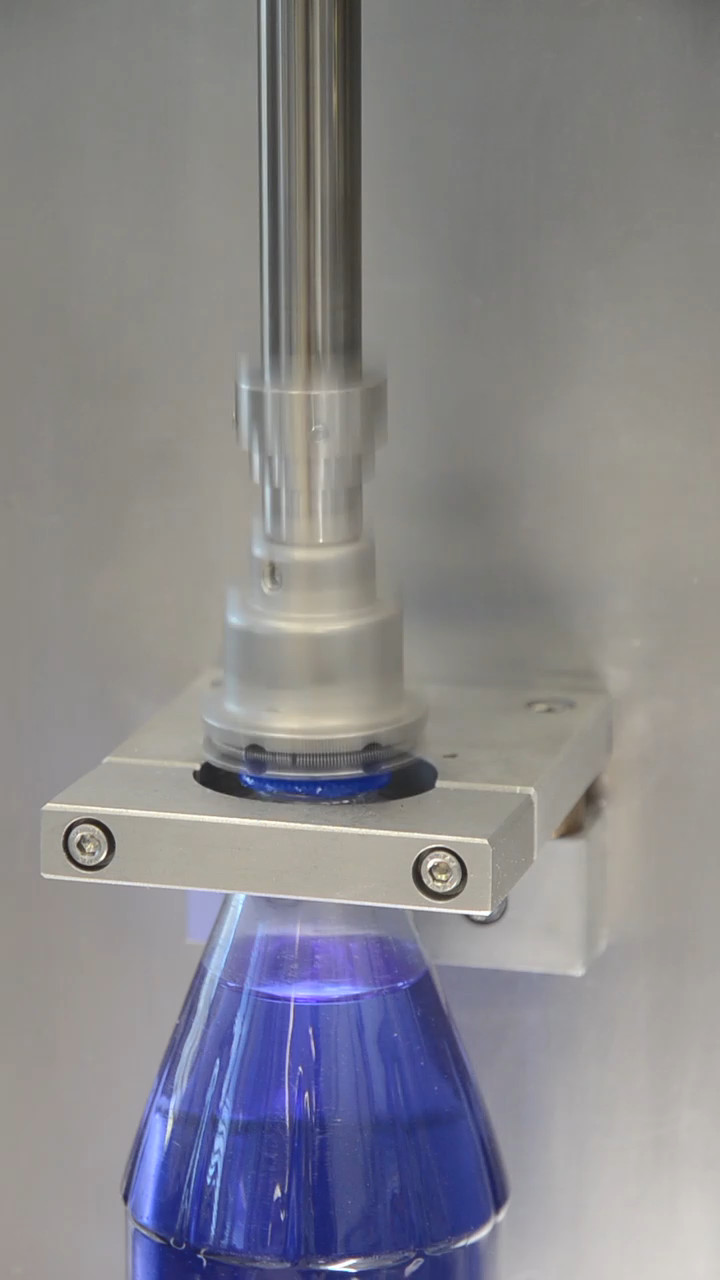
High-speed Capping
High speed Capping is a typical application example for these motors. Caps on bottles need to be applied quickly, accurately and in a repeatable manner with feedback if there are any problems.
As well as fully automating the process, the PR02 offers traceability by continuous monitoring in real time, every capped unit so that it can be traced.
A quality check can be continuously applied, knowing all process parameters on time, makes it possible to check whether the cap is applied correctly or not.
On-the-fly process optimisation is achieved by altering specific parameters, such as torque , force, speed, position etc.
Maintenance can be achieved through continuous monitoring of temperature- and current- conditions allowing prediction of oncoming failure or maintenance needs.
After picking the cap, a typical capping process involves moving the cap towards the bottle in linear position mode and then switching on-the-fly to a Constant force mode to place the cap on the bottle. The rotary motion can then turn to find the start of the thread while applying a constant linear force. Once found, the cap is rotated to a predefined closing angle with an optional torque check.
Using the PR02 eliminates the need for compensation springs and couplings and torque clutches.
Screw tightening and Assembly
The tightening of screws and assembly of products are required in almost everything that is manufactured. Now though, higher tolerances and greater feedback is needed in a modern production process.
Using the LinMot PR02, high-speed assembly can be achieved while giving feedback on screw thread quality, length and torque accuracy better than 1%.
Linear motors mimic the heart in testing of artificial cardiovascular devices
Linear motors are used in increasingly diverse applications and much of the pioneering work is being done in our universities. This is the first in a series of posts that looks at some of the more interesting and promising applications and starts by looking at the work of Queen Mary University of London who are using linear motors to simulate the human cardiovascular system. Heart disease is the most common cause of death globally and this important research will help in the development of treatments by allowing reliable in vitro (outside the body) testing of artificial heart devices.
Dr Paula Ruiz-Hincapie (Queen Mary University of London), Professor Theodosios Korakianitis (Saint Louis University) and their collaborators have designed a device which simulates the human cardiovascular system and significantly improves on previous implementations so allowing reliable in vitro testing of artificial devices such as heart valves, ventricular assist devices (VADs) and mechanical circulatory support (MCS) devices. Artificial devices need to be tested in vitro prior to in vivo testing and this work improves the reliability of testing so allowing development and introduction of new medical devices.
“This work by, funded by the NHS, has now moved from testing and proof of concept to the development of new medical devices for implantation,” adds Paula.
Unsurprisingly, simulation of the cardiovascular system is a complicated and challenging task requiring simulation of in vitro flow rates, pressures and other parameters representing normal and diseased conditions of the human cardiovascular system. Such devices are sometimes called bioreactors or ‘mock’ simulators of cardiovascular loops (SCVLs). Most SCVLs only simulate the systemic circulation (the circulation of the blood to all parts of the body except the lungs) and have other limitations such as capturing accurately the pressure waveform. Paula Ruiz, Theodosios Korakianitis and their collaborators from Shiraz University of Technology, Barts and the London NHS Trust have designed and implemented a mechanical cardiovascular system using linear motors which models all four chambers of the heart and the systemic and pulmonary circulation loops. Systemic circulation is the part of the cardiovascular system which carries oxygenated blood away from the heart to the body, and returns deoxygenated blood back to the heart. Pulmonary circulation is the portion of the cardiovascular system which carries deoxygenated blood away from the heart, to the lungs, and returns oxygenated (oxygen-rich) blood back to the heart.
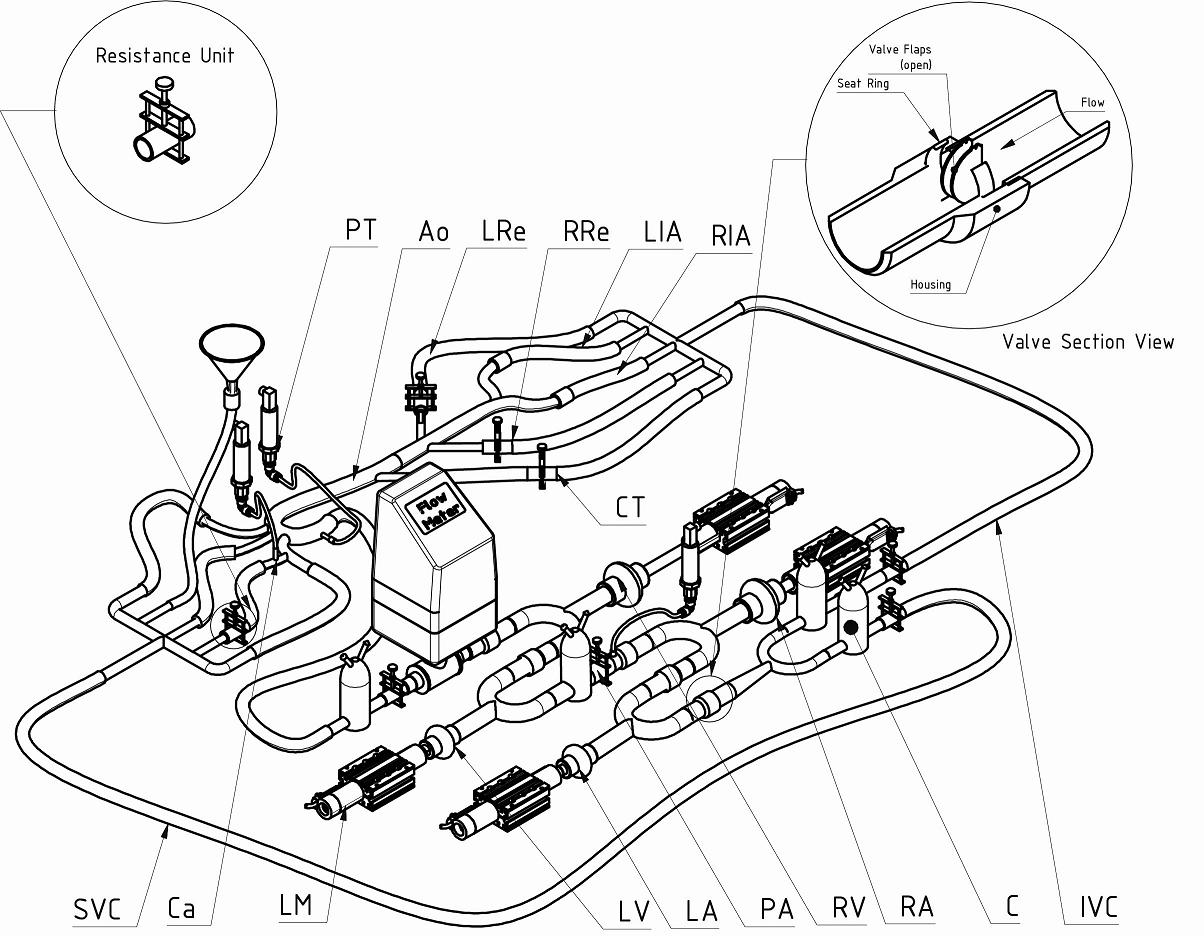
Diagrammatic representation of the SCVL. Ao: aorta artery; C: compliance; Ca: carotid artery; CT: celiac trunk; IVC: inferior vena cava; LA: left atrium; LM: linear motor; LV: left ventricle; PA: pulmonary artery; PT: pressure transducer; RA: right atrium; Re: renal artery; RV: right ventricle; SVC: superior vena cava.
Four rubber gaiters of the correct size are used to model the four chambers of the heart which are accurately activated by a separate linear motor (P01-37×120 from LinMot) to simulate the suction and ejection stages. The linear motors consist of a stator and a slider accurately controlled by an E300 LinMot controller with four channels to accurately the position of each slider according to a predefined time-varying elastance function. This allows precise emulation of the contraction and filling phases as found in the native cardiac muscle. A high speed, high performance data acquisition card from National Instrument is used to send the desired displacement trajectories from the PC to the linear motor controller and to read the measurement signals from the pressure transducers and the flow-meter to the PC. NI LabView software is used for the desired trajectory generation and monitoring tasks.
This research demonstrated that the use of linear motors for displacing individual chambers provides an accurate technique for emulating different physiological (rest and exercise) and pathological conditions of the human cardiovascular system with and without mechanical circulatory support. The experimental results demonstrated the capability of this device to replicate normal and diseased conditions. The details of the experimental simulation of the various conditions and the measurements recorded to assess the success of the simulation are published in Artificial Organs, 2013 Vol 37 No 6 p 549-560.
Paula Ruiz-Hincapie is now affiliated to the University of Hertfordshire where her work has expanded into an exciting new area. Applying her experience of simulating the cardio vascular system with linear motors, she intends to use these motors to stimulate cardiovascular cells to reproduce themselves. The intention is to populate a bespoke geometry or scaffolding that can then be transferred to a patient for replacement of a malfunctioning organ or tissue.
“The cells will be grown in the laboratory and supplied with oxygen and nutrients. Linear motors will used to apply a force profile simulating that of the cardiovascular system. We hope, one day, to use cells grown in this way to implant into diseased hearts replacing damaged tissue. To do this type of transplant today tissues would be taken from a washed and sterilised cadaver, but there is always a risk of infection or rejection by the recipient’s immune system. Our work hopes to overcome these issues by growing replacement cells from cells taken from the recipient and thereby overcoming these problems,” Paula continues.
We look forward to hearing more about this innovative work in the future and wish Paula the very best with her research.
To learn more about LinMot’s range of linear motors please take a look at our website or contact us to discuss your application.
In Vitro Cardiovascular System Emulator (Bioreactor) for the Simulation of Normal and Diseased Conditions With and Without Mechanical Circulatory Support
*Paula Ruiz, *Mohammad Amin Rezaienia, ‡Akbar Rahideh, †Thomas R. Keeble,
†Martin T. Rothman, and §Theodosios Korakianitis
*School of Engineering and Materials Science, Queen Mary University of London; ‡Shiraz University of Technology, School of Electrical and Electronic Engineering, Shiraz, Iran; †Department of Cardiology, Barts and the London NHS Trust, London Chest Hospital, London, UK; and §Parks College of Engineering,Aviation and Technology, Saint Louis University, St. Louis, MO, USA
Last month, scientists found bacteria resistant to the drug (colistin) which is used when all others drugs have failed and warn that this could mark the beginning of a post antibiotic era with people dying from untreatable infections. It is likely that resistance emerged after colistin was overused in farm animals.
Preventive medications, including antbiotics are widely used in farming and aquaculture. Norway, where fish is the third most important export has recently succeeded in nearly completely eliminating antibiotics. At their peak, in 1987, Norwegian fisheries alone used about 50 tonnes of antibiotics per year – more than were prescribed for the entire population of Norway in the same time period. Now, Norwegian fish farms are using less than 100 kg per year and 98% of all salmon farmed in the country have absolutely no exposure to antibiotics. This was made possible by vaccinating the fish.
This procedure is difficult, however, because up to now each fish has had to be manually injected with the vaccine using a syringe. Considering the number of fish raised annually – 1.4 million tons of salmon in aquaculture worldwide in 2010 – this procedure had reached its limits. Drives and Controls have reported on the automation of the vaccination process by a Norwegian machine builder, Skala Maskon, whose system allows a single operator to anaesthetise, sort, singulate and vaccinate up to 20,000 fish every hour. The machine not only vaccinates many more fish but also ensures that the quality of the vaccinations is much higher than humans can achieve.
The machine consists of one or two vaccination modules, each equipped with four vaccination stations. An image processing system first measures each fish and generates information that is used to calculate the point of injection. The vaccination station is then positioned using a linear motor, making it possible to hit the optimal oinjection site for each fish with a precision of better than 98%. The length of the fish, as determined by the image procesing system, is also used to calculate the depth of the injection. A sensor on the needle monitors the injection process and the vaccine dosage for each fish. As a result, the mortality is said to be less than 0.02%.
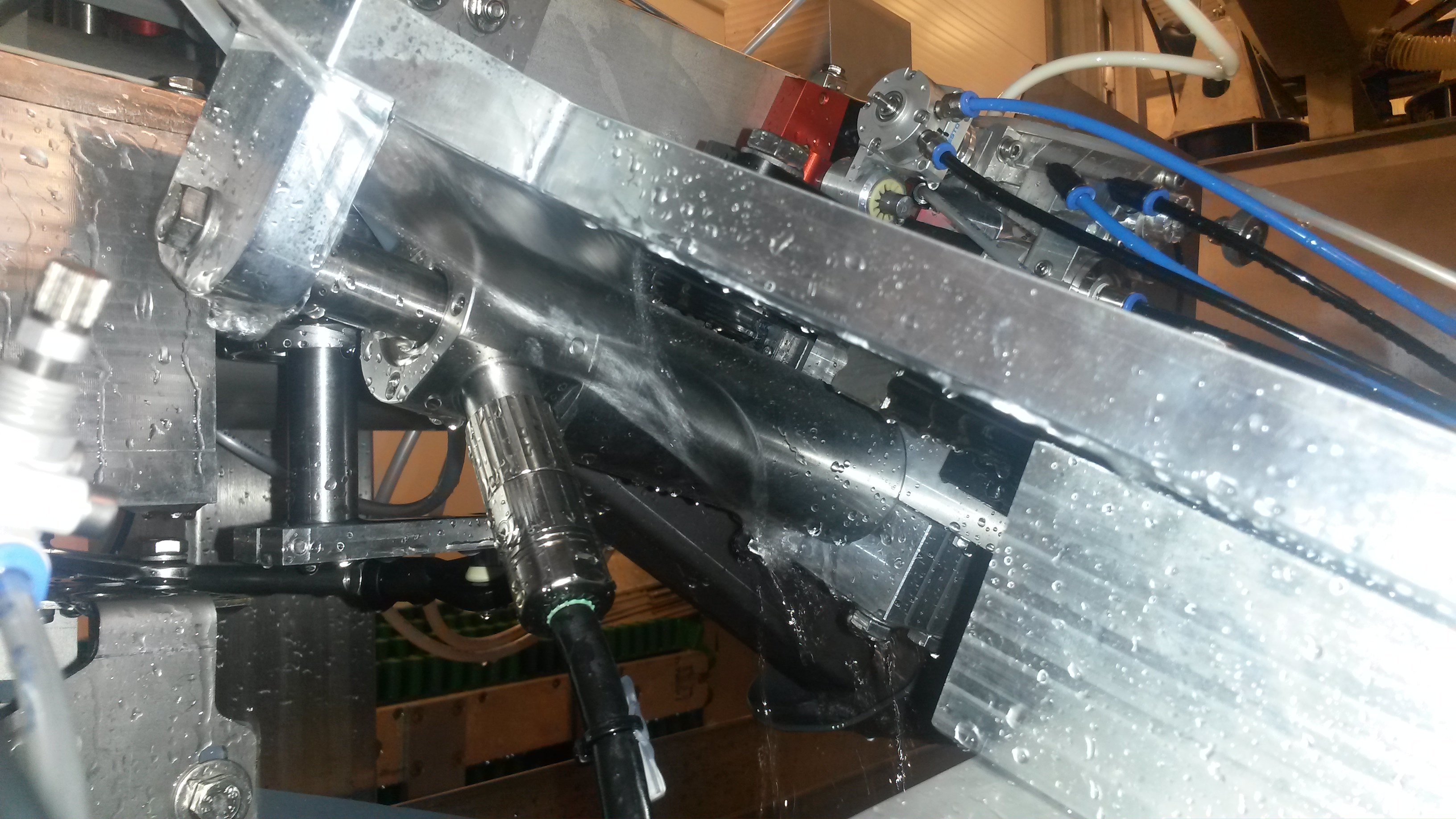
LinMot linear motors were chosen for their speed, precision, compact form and their ability to meet the necessary hygiene requirements. The motors are made of stainless steel and protected to IP69K, contain no gaskets and all the connections are welded. The motors are potted to prevent condensation and they have no protruding parts or gearboxes (unlike conventional servomotors).
Solution Details
The stator model, PS01-37x120F-HP-SSC-R used in the vaccination unit, has an outer diameter of 48 mm and length of 296 mm and when used together with the appropriate slider is able to apply a constant force of up to 210 N over the entire range of its stroke. A high-clearance variant, PL01-19×350/260, with a stroke of 120 mm was selected for the vaccination unit. The motor is controlled by a model E1100-VF-HC servo inverter, also from LinMot, which supports both force control and speed control and is designed for integrating the linear motors into systems with a master axis controller.
The motor’s force or speed is set by the master position controller via a ±10V differential analogue signal. Either the internal LinMot measurement system built into the motor or a high-precision external measurement system can be used for feedback. Simple positioning controls can actuate the E1100-VF controller with stepper motor or directional pulse signals. For testing and commissioning, the VF controller can also be operated in point-to-point mode, with four freely programmable end positions.
There has been a “media frenzy” of articles concerning the risks and the impact of robotics as succinctly summarised by Tony Sacks in Drives and Controls’ editorial this month – A threat to humanity or an end to dull jobs. As far as industrial robots go the media seems to be interested in two main issues: whether robots can do the jobs of humans and if so what are the implications for employment. This post looks at some of the research into automation (including robotics) that has been the source for many of these stories.
Will your job become automated?
The BBC reports that about 35% of current jobs in the UK are at high risk of computerisation over the following 20 years, according to a study by researchers at Oxford University and Deloitte. On their website you can type in your job and find what the likelihood is of finding yourself replaced by a robot. Oxford University academics, Michael Osborne and Carl Frey, have calculated the probability of automation for each job based on nine key skills required to perform it. These key skills are defined as social perceptiveness, negotiation, persuasion, assisting and caring for others, originality, fine arts, finger dexterity, manual dexterity and the need to work in a cramped work space. Not being able to resist, I selected “Design and Development Engineer” to find out that the risk of automation was quite unlikely (3% probability of automation). Surprisingly, as the technology is already available from Quin Systems and others, I found out that “Packer, Bottler, Canner and Filler” had a risk of automation of “not very likely” (38% probability of automation.)
Impact on employment
Concerns have been voiced about the forecast decline in, particularly, low-paid employment and the resulting social implications. Counter arguments made by advocates of automation include:
– That without the productivity gains enabled by automation jobs will be lost to companies that embrace automation.
– To some extent automation will create higher paid and higher skilled jobs to install and manage machines. (Forrester research estimates 16% of jobs will be automated, jobs equivalent to 9% of today’s workforce will be created so leaving a net loss of 7%.)
– Completely new jobs will be created in the future which we can’t predict today.
Mark Muro and Scott Andes, in the Harvard Business Review conclude that robots seem to be improving productivity but not costing jobs. They cite the analysis offered by George Graetz and Guy Michaels of Uppsala University and the London School of Economics which finds that industrial robots have contributed to 10% of total GDP growth in the countries studied and 16% of labour productivity growth over that time period. Muro and Andes have analysed the data from this study and have found no correlation between a country’s use of robots and the percentage of manufacturing jobs lost. For example, despite the installation of far more robots between 1993 and 2007, Germany lost just 19% of its manufacturing jobs between 1996 and 2012 compared to a 33% drop in the US.
As specialists in machine automation, our take on this may well be thought of as biased so instead of wading into the argument I thought I’d think about some of the implications for manufacturers of automation equipment and robotics.
Training for engineers and designers in automation, by colleges and company certification programmes, is recognised in the industry and well respected. But what about the recognition of training for line operators primarily affected by the introduction of line automotion? Individual training is provided with the introduction of any machine. At a minimum, operators are trained how to monitor, clean, lubricate and adjust the machine and change products. In fact, Quin Systems incorporates operator training prior to installation on site as part of the acceptance process. Perhaps we could do more to ensure that the benefits of our training are understood and accessible to line operators and that the skills learnt are recognised and valued. More extensive use of remote diagnostics could be used for mentoring employees and developing skills.
The Future
These researchers are pointing to the ability of automation to increase productivity and so maintain a company’s competitiveness leading to growth so lessening any impact on employment. The UK has been one of the slowest nations to adopt automation; I wonder if the obvious interest from the media will impact future uptake.
The Boston Consulting Group has produced a study on the adoption of advanced robots which is well worth reading. It predicts that by 2025, adoption of advanced robots will boost productivity by up to 30% in many industries. BCG remind us that as wage costs rise, it is increasingly important for manufacturers to improve the output per worker to stay competitive.
Robots currently only perform about 10% of manufacturing tasks whilst by 2025, BCG predict this figure may rise to 25%. The factors driving this uptake are the cost reductions and increased performance of robots. Industry adoption is strongly driven by the relative cost of wages to the cost of robotics. Industries, such as food, are categorised as behind other industries, possibly because wage cost is a relatively low at 15% of the total production cost. Interestingly at Quin Systems we have noticed a good growth in installations in the food industry. Does this signal the start of the age of advanced automation?
This website uses cookies to improve your experience. We'll assume you're ok with this, but you can opt-out if you wish.AcceptRead More
Privacy & Cookies Policy
Privacy Overview
This website uses cookies to improve your experience while you navigate through the website. Out of these cookies, the cookies that are categorized as necessary are stored on your browser as they are as essential for the working of basic functionalities of the website. We also use third-party cookies that help us analyze and understand how you use this website. These cookies will be stored in your browser only with your consent. You also have the option to opt-out of these cookies. But opting out of some of these cookies may have an effect on your browsing experience.
Necessary cookies are absolutely essential for the website to function properly. This category only includes cookies that ensures basic functionalities and security features of the website. These cookies do not store any personal information.
Any cookies that may not be particularly necessary for the website to function and is used specifically to collect user personal data via analytics, ads, other embedded contents are termed as non-necessary cookies. It is mandatory to procure user consent prior to running these cookies on your website.
Functional cookies help to perform certain functionalities like sharing the content of the website on social media platforms, collect feedbacks, and other third-party features.
Performance cookies are used to understand and analyze the key performance indexes of the website which helps in delivering a better user experience for the visitors.
Analytical cookies are used to understand how visitors interact with the website. These cookies help provide information on metrics the number of visitors, bounce rate, traffic source, etc.
Advertisement cookies are used to provide visitors with relevant ads and marketing campaigns. These cookies track visitors across websites and collect information to provide customized ads.